
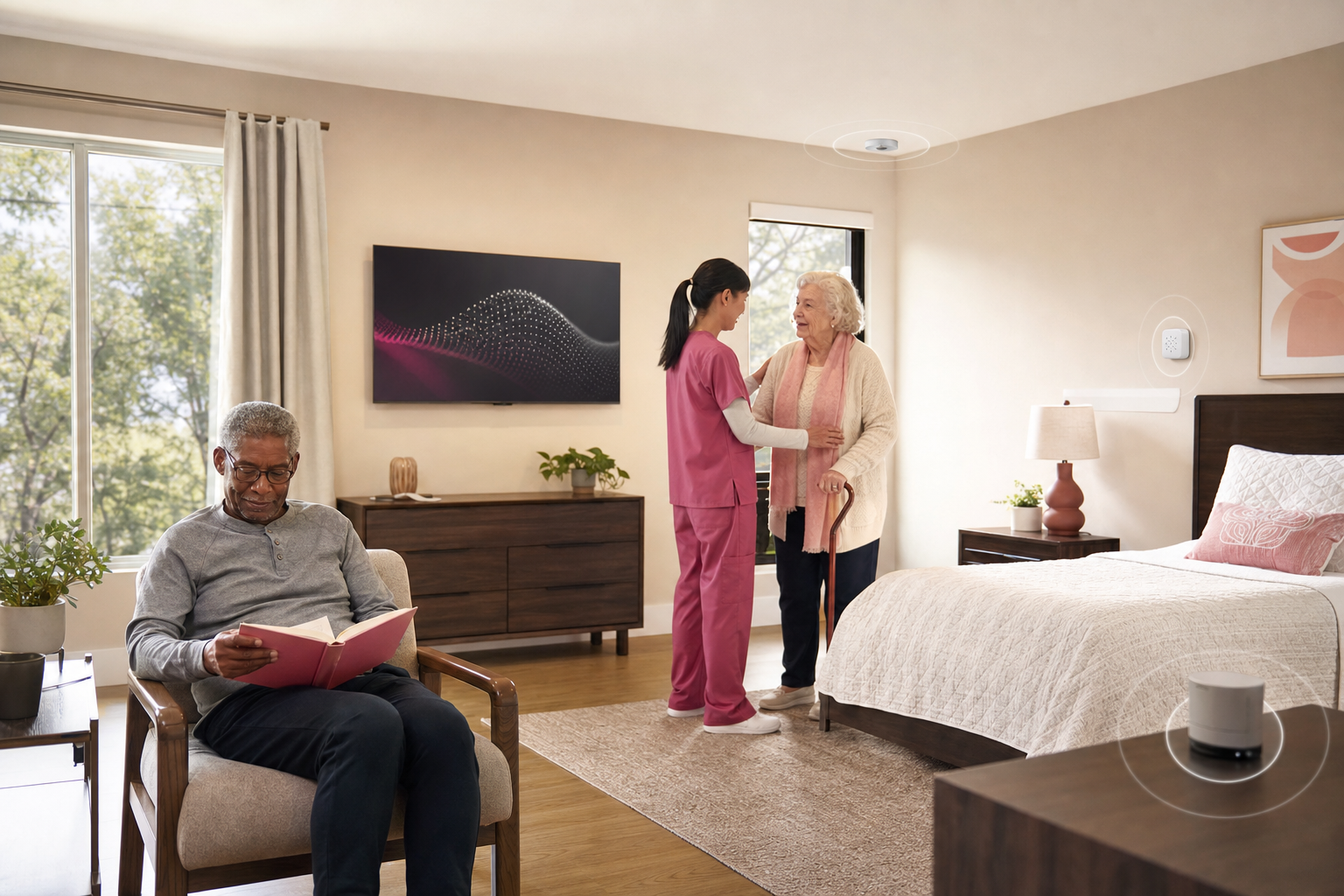


As executive directors of senior care homes, ensuring the safety and well-being of your residents...
Aparna Pujar , Founder and CEO, Zemplee Inc.
Vendors marketing "ambient monitoring" or "fall detection" solutions to senior living operators frequently describe their offering with a single phrase: the system uses motion sensors. On its own, this description conveys very little useful information. A passive infrared sensor of the kind integrated into a security camera, a millimeter-wave radar chip of the kind used in automotive collision-avoidance systems, and a capacitive sensor embedded in a mattress pad are all classified as "motion" or "presence" sensors, yet they share almost no common characteristics: they differ in underlying physics, cost, failure modes, and their implications for resident privacy and dignity.
This guide is intended for those responsible for evaluating this variety of technologies: executive directors assessing vendors, chief information officers conducting technical due diligence, and nurses or clinicians seeking to understand why a given sensor did or did not register an event. It examines the six sensing technologies most commonly encountered in senior care — PIR, mmWave, 60GHz, general radar, lidar, and capacitive sensors — describing how each functions, what its specifications mean in practice, and where each is, and is not, an appropriate fit.
Quick summary: PIR (passive infrared) detects heat-signature movement; it is inexpensive and has an established field record, but it cannot detect a person who is still or positioned behind glass. mmWave radar detects motion and breathing using reflected radio waves, functions through fabric and in darkness, and is widely used for privacy-preserving fall and presence detection, though it is more prone to false alarms and requires a more involved installation process. 60GHz is a specific, short-range band of mmWave that stays contained to a single room. Radar is the general physics — reflected radio waves — that mmWave is a subset of. Lidar uses laser light rather than radio waves to build a precise 3D map of a room. Capacitive sensors work differently from all of the above: they detect a body's presence directly on a bed or chair by measuring a change in electrical capacitance, making them the right tool for instant bed-exit and chair-exit alerts rather than room-wide monitoring.
Why These Are Different Technologies, Not One
Each technology below solves a related but distinct problem — noticing when a person is present, moving, or absent — using a different physical signal: heat, radio waves, light, or an electric field. That choice of signal determines what the sensor can and cannot do: whether it can tell a fall from someone sitting down quickly, whether it can detect a resident who has stopped moving, whether it works through a door, and whether it monitors a whole room or a specific piece of furniture.
1. PIR (Passive Infrared)
How it works: A PIR sensor is the same technology used in a motion-activated porch light. It emits nothing; it passively measures changes in infrared heat within its field of view, the way a person's body temperature (about 98.6°F) stands out against a cooler wall. PIR is also the technology behind decades of burglar alarms and commercial security systems — that long track record is a large part of why it remains inexpensive, reliable, and widely deployed: the physics are simple and the failure modes are well documented.
Key specifications:
- Detects infrared wavelengths of roughly 8–14 micrometers, the band human bodies radiate most strongly in.
- Uses a pyroelectric crystal behind a segmented Fresnel lens or mirror, which divides the field of view into multiple "zones."
- Works differentially, comparing zone to zone, so it only registers a signal when a heat source moves across zones — a person standing still produces no output.
- Range detection: Varies by sensor design, optics, placement, and environmental conditions. As one real-world example, PIR sensors used in Zemplee deployments can provide detection ranges of up to approximately 40 feet, depending on the model and installation.
- Power draw is minimal (microamps at rest), which is why PIR units commonly run for years on a coin-cell or AA battery, with no electrician or power outlet required.
- Installation is typically peel-and-stick or a single screw, with no aiming or calibration needed.
Considerations for care settings: PIR's central limitation in a care setting is not a defect; it follows directly from how the sensor operates. A resident who has fallen and stopped moving, or who is sitting motionless following a stroke or cardiac event, produces no signal at all. PIR also cannot see through glass or walls, and can register false triggers from HVAC vents, sunlight, or pets.
That same design carries a corresponding benefit: PIR-based fall logic typically flags an event based on how long a resident remains motionless in an unusual location, rather than on the speed of the movement itself. A resident who lowers to the floor briefly for a stretch generally does not remain there long enough to cross that threshold, so PIR tends to generate fewer false alarms for fast, intentional floor movements. The trade-off is that this same logic can be slower to recognize, or can miss entirely, a real fall that does not fit the expected pattern.
Beyond individual events, passive sensing can also help care teams understand changes in a resident's daily activity and movement patterns over time.
2. mmWave Radar
How it works: Millimeter-wave (mmWave) radar transmits radio waves and measures the reflection, the same underlying principle as sonar, using radio energy traveling at the speed of light instead of sound. It is the technology behind most modern fall-detection and "contactless vitals" sensors, because it is sensitive enough to register movement as small as a chest rising and falling.
Key specifications:
- Operates in the 24–300 GHz range (wavelengths of 1–10 mm), most commonly using FMCW (Frequency-Modulated Continuous Wave) signal processing.
- Measures range, angle, and velocity simultaneously by analyzing the phase and frequency shift (the Doppler effect) of the reflected signal.
- Sensitive enough to detect sub-millimeter chest-wall movement, enabling contactless respiration and heart rate estimation — a trend indicator, not a diagnostic reading. These estimates are not clinical-grade or FDA-cleared vital-sign measurements; a resident being actively monitored for a cardiac or respiratory condition still requires a purpose-built medical-grade device, such as a pulse oximeter or ECG often as part of the remote patient monitoring program, rather than a radar-derived estimate.
- Reads motion and reflection rather than light or heat, so it functions in total darkness and through fabric such as bedsheets, clothing, or curtains.
- Does not capture an image. The raw output is a point cloud or radar signature, not a picture, which is the core privacy advantage over cameras.
- Unlike PIR, this continuous processing load generally rules out coin-cell battery operation. Power and installation requirements vary considerably by implementation. Many continuously operating mmWave systems require mains or wired power and careful wall or ceiling placement.
Clinical relevance: mmWave addresses PIR's central gap: it can detect a person who is present but motionless, and can estimate breathing and heart rate trends without a wearable device. That capability is useful for flagging a change worth a closer look, but it is not a substitute for medical-grade monitoring.
mmWave's sensitivity is also a double-edged characteristic. Because mmWave fall-detection algorithms typically work by measuring the speed of a body's descent, they can also register benign, fast movements as potential falls — a resident who lowers themselves quickly into a floor stretch or yoga pose, sits down abruptly, or bends quickly to pick something up can generate a velocity signature similar enough to an actual fall to trigger an alert. In practice, mmWave systems tend to have a higher false-positive rate on fall events than PIR for this reason, which is why mature deployments pair the raw sensor with a learning layer that adapts to each resident's typical movement patterns rather than relying on a single fixed speed threshold. Installation is also a meaningful trade-off: mmWave requires a more involved setup than PIR, since it needs access to power and careful placement rather than a rapid, tool-free installation.
Sensor technology, however, is only one component of a comprehensive fall prevention strategy in senior care.
3. 60GHz (A Specific Band of mmWave)
How it works: 60GHz is not a separate technology from mmWave — it is a specific, unlicensed radio band that behaves somewhat differently because of physics unique to that frequency.
Key specifications:
- Sits within the broader mmWave range but is treated separately because most countries have opened 5–7+ GHz of unlicensed spectrum around 57–71 GHz, used commercially for WiGig (IEEE 802.11ad/ay) and increasingly for sensing chips.
- Oxygen molecules in the air absorb radio energy strongly at 60GHz, which shortens usable range to roughly 5–10 meters. This is a limitation for communications, but an advantage for sensing, since the signal naturally stays contained to a single room rather than leaking into a neighboring suite.
- The short wavelength (approximately 5 mm) allows very compact antennas and fine range resolution, often down to a few centimeters.
- Shares mmWave's privacy profile: no image capture, functions in the dark, and penetrates fabric and drywall to a limited degree.
Relevance for multi-resident buildings: 60GHz's natural signal containment is a genuine advantage in congregate care settings. It reduces the likelihood of a sensor in one room registering activity in an adjacent one, which matters both for data accuracy and for maintaining resident and family trust.
\
4. Lidar (Light Detection and Ranging)
How it works: Lidar operates on the same basic principle as radar, but uses pulses of laser light instead of radio waves. It builds a precise 3D map of a room, effectively a wireframe model updated many times per second, containing no color and no identifiable image.
Key specifications:
- Typically uses near-infrared laser light, around 905nm or 1550nm, measuring time-of-flight or phase shift of the reflected pulse.
- Produces detailed 3D point-cloud data, with spatial precision that can reach the millimeter-to-centimeter range depending on the sensor, distance, and operating conditions.
- High-resolution spatial data can support analytics for posture, movement, and gait—such as distinguishing different types of downward movement or identifying changes in gait patterns over time, distinguishing "sat down quickly" from "fell," or tracking a shuffling gait that signals rising fall risk over time.
- Requires line of sight; it cannot see through walls, fabric, or solid obstructions the way radar can.
- Historically the most expensive option per unit, though solid-state lidar costs have declined significantly in recent years.
Best application: Lidar's cost premium is best justified in settings where fine-grained fall discrimination or gait- and fall-risk analytics are the priority, and where a single, unobstructed room view is realistic — a bedroom or living area, for example, more so than a busy dining hall.
5. Capacitive Sensors (Bed and Chair Occupancy)
How it works: Capacitive sensing works on a different principle from the technologies above. Rather than reading heat, radio waves, or light, it measures a change in electrical capacitance between electrodes when a human body — which has a high dielectric constant and a partially conductive composition due to water content — enters or leaves an electric field. This is the same underlying principle used in touchscreens and proximity switches, applied here to detect whether a specific surface, most often a bed or chair, is occupied.
Key specifications:
- Detects presence through a measurable shift in capacitance rather than through any transmitted radio or light signal, meaning there is no line-of-sight requirement and no dependence on room lighting.
- Typically built into a thin electrode pad or mat placed under a mattress sheet or within a chair or wheelchair cushion. Some designs use a fringing electric field that senses a body's proximity a few centimeters above the surface, allowing the system to register a resident beginning to sit up before they have fully left the bed.
- Response time is near-instantaneous, generally well under a second, which is clinically significant for bed- and chair-exit alerts, where an early cue matters more than a detailed motion profile after the fact.
- Reports a binary or graduated occupancy state, such as "in bed," "sitting up," or "out of bed," rather than a full movement, breathing, or fall signature.
- Power draw is low; sensors are typically wired to a bedside or chair-mounted control unit, though wireless reporting variants exist. Per-sensing-point cost is comparable to PIR, though a complete bed-exit system, including pad, control unit, wiring, and nurse-call integration, typically costs more per bed than a single PIR unit covering an entire room.
Clinical relevance: Capacitive bed and chair sensors address a need that room-level technologies are not designed to meet: knowing the instant a specific resident leaves a specific surface, before a fall has the opportunity to occur. A memory-care resident who is prone to attempting unassisted transfers benefits more from a chair-exit alert timed to the moment they begin to rise than from a room-level sensor that registers movement only after they are already up and walking. Capacitive sensing complements room-level motion sensing rather than replacing it: it answers "did this resident leave this exact surface," while PIR, mmWave, radar, and lidar answer "what is happening in the room."
Comparing the Sensors at a Glance
|
PIR |
mmWave Radar |
60GHz |
Lidar |
Capacitive (Bed/Chair) |
|
|
Detects a stationary person |
No |
Yes |
Yes |
Yes |
Yes, on the sensing surface only |
|
Works in total darkness |
Yes |
Yes |
Yes |
Yes |
Yes |
|
Monitors a room vs. a surface |
Room |
Room |
Room |
Room |
Surface (bed/chair) only |
|
Captures an image |
No |
No |
No |
No (3D map only) |
No |
|
Contactless vital signs |
No |
Trend estimate only, not clinical-grade |
Trend estimate only, not clinical-grade |
No |
No |
|
Relative cost |
$ |
$$ |
$$ |
$$$ |
$ per sensing point |
|
Power source |
Battery, no outlet needed |
Requires power outlet/hardwire |
Requires power outlet/hardwire |
Requires power outlet/hardwire |
Wired to bedside/chair control unit |
|
Install complexity and Ease |
Easiest. Peel-and-stick, minutes |
Involved — precise aim & mounting |
Involved — precise aim & mounting |
Most involved — calibrated placement |
Moderate — pad placement + control unit wiring |
|
False-positive risk on falls |
Lowest — flags on dwell time, not movement speed |
Higher — sensitive to velocity signatures that mimic falls |
Higher — same as mmWave |
Lower — resolution supports true posture recognition |
Not applicable — alerts on exit, not fall classification |
|
Interference with pacemakers/ICDs |
No known risk — no RF emission |
Low/theoretical — active RF, but low unlicensed power; no documented adverse-event pattern |
Low/theoretical — same reasoning as mmWave |
Not applicable — optical (laser), not RF |
No known risk — no RF emitted into the room |
|
Pet detection / filtering |
Yes, via optical zoning — many "pet-immune" PIR models mask the lower field of view, at the cost of reduced sensitivity to a person low on the floor |
Possible, via AI-based size and velocity classification — requires processing beyond the raw sensor, not guaranteed on every product |
Possible — same classification approach as mmWave, same caveat |
Yes — precise 3D shape and height data make person/pet discrimination comparatively reliable |
Partial — a calibrated capacitance/weight threshold can filter small pets, but a larger animal on the surface may still register as occupied |
|
Best-fit use case |
Presence, Fall detection and pace through an intelligence layer |
Fall detection, presence, non clinical grade vitals like respiratory rate and heart rate. |
Room-contained privacy monitoring |
Precision gait & fall-risk analytics |
Immediate bed/chair-exit alerting, behavioral |
Matching the Technology to the Care Moment
No single sensor covers every scenario, which is why mature ambient monitoring programs combine technologies rather than relying on one:
- Older Adults at elevated fall risk during bed or chair transfers are best served by capacitive sensing built into the bed or chair itself, which flags the moment of exit before a room-level sensor would register any change. mmWave (60 GHz) is also a good candidate - however limited capability to distinguish between a pet and human can lead to higher false positives.
- Rooms without a convenient power outlet, or fast-turnaround retrofits across many units, often make PIR the practical and most economical choice even where mmWave would otherwise be preferable — installation reality is a genuine constraint - both cost and labor wise, not a minor footnote.
- Sleeping residents need a sensor that can distinguish "breathing normally" from "motionless and in distress" — PIR cannot do this by design, but mmWave can. However, when PIR is used due to limitation from installation challenges, other clinical grade bed occupancy sensors can be used to detect respiratory rate and heart rate.
- Bathrooms, the highest-risk room in the home or a living unit in assisted living and the one where cameras are least acceptable, can be served by PIR, radar and mmWave, which function through steam and low light without capturing an image. These privacy-preserving technologies can also help support older adults who are aging safely and independently at home.
- Wandering risk in memory care - Multiple sensor types can contribute to elderly activity tracking, including changes in movement patterns and potential wandering behavior.
- Fall-risk prediction — identifying a slowing gait weeks before a fall — benefits from lidar's or high-resolution mmWave's spatial precision. However fall-risk prediction is complex and does not depend on gait alone. Medication, sleeping habits, hydration habits, prevalent chronic conditions, space planning impact the fall risk score.
FAQ
Which sensor technology is best for senior care?
There is no single best sensor technology for senior care. PIR is well suited to low-cost, battery-powered motion monitoring; mmWave and radar can detect stationary residents and finer movement; lidar provides high-resolution spatial and gait information; and capacitive sensors are particularly useful for bed- and chair-exit detection. The best choice depends on the care setting, resident risk, privacy requirements, installation constraints, and the event being monitored.
Do motion sensors like mmWave or lidar record video?
No. PIR reads a heat differential, radar and mmWave read reflected radio waves, lidar builds a colorless 3D point cloud, and capacitive sensors read a change in electrical capacitance. None of them produce a picture of a resident.
Which sensor can detect a fall when the resident stops moving?
PIR, mmWave radar, and lidar can all be used successfully for fall detection, although they rely on different sensing technologies and detection methods. No sensor is perfectly accurate on its own. An intelligence layer that interprets sensor data in context can help reduce false positives and improve the reliability of fall detection.
Why are cameras not more commonly used in senior living communities?
Cameras raise dignity and consent concerns, particularly in bathrooms and bedrooms, and many residents and families decline them outright. Radar, mmWave, and lidar deliver comparable or better fall and presence detection without capturing an identifiable image.
Which technology is most cost-effective for a large community?
PIR is the least expensive option per unit and has a long, proven track record from decades of use in the security industry, but it leaves a real gap for stationary residents.
Why does mmWave raise false fall alarms for things like floor exercises or yoga?
Most mmWave fall detection works by measuring how quickly a body moves toward the floor. A resident who lowers themselves quickly into a yoga pose, or sits or kneels down abruptly, can generate a velocity signature similar enough to a real fall to trigger an alert — the sensor is responding to speed, not intent. PIR-based systems are generally less prone to this specific false alarm, because their fall logic typically looks at how long someone remains motionless in an unusual location rather than how quickly they got there — though that same design is also why PIR can be slower to detect, or can miss, a real fall.
Can these sensors distinguish between a resident and a pet?
This depends on the specific technology, and often on the individual product, rather than on the underlying physics alone. PIR addresses this through "pet-immune" lens designs that mask the lower portion of the field of view, so a small animal near the floor does not register — though that same masking reduces sensitivity to a person who is positioned low to the ground, such as after a fall. Lidar's precise three-dimensional shape and height data generally makes person-versus-pet discrimination comparatively reliable. mmWave and 60GHz can filter pets using AI-based size and velocity classification, but this is a software capability layered on top of the raw sensor and is not included in every mmWave product. Lower-frequency general radar has less spatial resolution to work with, making reliable discrimination more difficult. Capacitive bed and chair sensors can be calibrated with a capacitance or weight threshold to disregard small pets, though a larger animal on the surface may still register as occupied. Operators with resident pets or facility animals should request confirmation directly from a vendor on how, or whether, a specific product handles this, rather than assuming a capability based on the sensor category alone.
Is mmWave harder to install than PIR?
Yes. PIR is battery-powered and mounts with a screw or adhesive in minutes, with no aiming required. mmWave units draw more continuous power to run their radar processing, so they generally require a nearby outlet or hardwired power, along with careful placement — height, angle, and field of view — to obtain an accurate signal. This makes PIR the faster retrofit and mmWave the more deliberate install.
Can mmWave's breathing and heart rate readings replace clinical monitoring equipment?
No. mmWave's respiration and heart rate output is a contactless estimate derived from chest-wall movement, useful as a trend indicator or an early flag that something has changed, but it is not a clinical-grade or FDA-cleared vital-sign measurement. A resident on active cardiac or respiratory monitoring still requires a purpose-built medical device, such as a pulse oximeter or ECG. mmWave complements that equipment; it does not substitute for it.
Can mmWave or 60GHz sensors interfere with a resident's pacemaker or ICD?
There is no documented pattern of low-power mmWave or 60GHz sensing chips causing clinically significant interference with cardiac implantable devices. The sources cardiology guidance actually identifies as risks are strong magnetic fields, such as those from MRI machines, arc welders, and induction cooktops, not low-power unlicensed radar. That said, an absence of a documented pattern is not the same as a formal clearance for a specific product; operators caring for residents with pacemakers or ICDs should request the vendor's EMC test documentation (per IEC 60601-1-2) rather than assume it by default. PIR, lidar, and capacitive sensors carry no comparable concern: PIR and capacitive sensors emit no RF into the room, and lidar uses optical (laser) sensing rather than radio waves, so none of the three has an established interference pathway with implanted electronics.
A Note on the Evidence Base for mmWave and 60GHz
This section addresses the evidence base for mmWave and 60GHz directly, since the intent here is to inform rather than to oversell a comparatively new technology. mmWave and 60GHz sensing are meaningfully newer than PIR, which has been deployed in the field for decades, and that difference in maturity is worth stating plainly in two respects.
On safety, there is a substantial general body of research on RF exposure and electromagnetic compatibility, but comparatively little product-specific, long-term safety data on continuous-use mmWave presence sensors installed in bedrooms and living rooms where older adults often spend a lot of time, Nothing in the current evidence indicates a safety concern, but the absence of a dedicated long-term study is a genuine gap in the evidence base, not a minor technicality.
On clinical validity, the respiration and heart rate trends these sensors produce have not gone through the same validation pathway as an FDA-cleared vital-signs monitor. Most published accuracy data comes from vendor testing and early academic studies rather than large-scale clinical trials. This is precisely why this guide treats mmWave vital-sign output as a trend indicator throughout, rather than as a diagnostic reading. Older adults with COPD or cardiac conditions need monitoring precise enough to catch irregular breathing, desaturation, or arrhythmias — which a contactless mmWave trend estimate isn't validated to detect — and that these residents should keep relying on their prescribed clinical devices.
Neither point is a reason to avoid the technology. It is a reason to ask any vendor, Zemplee included, for specific safety and validation data rather than accepting industry-wide claims at face value.
FCC Compliance and Regulatory Considerations
For sensing devices that intentionally emit radiofrequency energy—such as radar and mmWave sensors used in the United States—buyers should verify that the finished device has the appropriate FCC authorization for its operating frequency and configuration. When a product incorporates an FCC-certified radio module, the finished device must still be used and integrated in accordance with the module's authorization conditions and any other applicable FCC requirements. Organizations should verify compliance with the device manufacturer before deployment.
Regulatory reference: Federal Communications Commission — Equipment Authorization
Where Zemplee Fits
This is exactly the decision Zemplee was built to simplify. Zemplee is not a hardware manufacturer: Zemplee Sense™ is built on established OEM sensor hardware — PIR, mmWave, and capacitive bed and chair sensors — selected and integrated specifically for senior living deployment rather than designed from scratch in-house. Each sensor type is deployed where its physics make the most sense: PIR for fast, battery-powered, broad-area coverage; mmWave for rooms where detecting a motionless resident in real time and capacitive sensors on beds and chairs for residents whose greatest fall risk occurs at the moment of transfer.
No individual sensor on this list is complete on its own, which is the underlying purpose of Zemplee's proprietary, patented Attentive AI™ — the learning layer to which all three sensor types report. Raw PIR data cannot register a resident who has gone still. Raw mmWave data can mistake a fast, deliberate movement for a fall and cannot, on its own, produce a clinical-grade vital sign. A capacitive sensor can indicate that a resident has left the bed, but not what occurred afterward. Cost and installation convenience are factors to be considered.
Zemplee's Attentive AI does not treat any single sensor as more capable than it actually is. Instead, it establishes each resident's individual baseline — typical movement patterns, usual dwell times, normal breathing range — and evaluates new readings against that baseline rather than a fixed, uniform threshold. This is what converts a PIR unit's zone-crossing signal, a mmWave chip's raw velocity data, and a capacitive pad's exit event into a single alert that a care team can act on with confidence, rather than either a missed event or a notification for every stretch, yoga pose, or routine transfer. This illustrates the broader role of AI in senior care: transforming continuous data into meaningful information that care teams can use to make more proactive decisions.
Communities using this approach have reported up to 9x fewer falls and 42% fewer hospital days. The objective was never to identify one "best" sensor technology; it was to relieve care teams of the burden of determining which technology addresses which risk, and to let the AI layer distinguish signal from noise.
The technology matters, but the objective is straightforward: residents retain their dignity, families receive substantive information rather than uncertainty, and care teams receive timely warning and guidance before an adverse event occurs so an appropriate action can be taken before they escalate into crisis.
Further Reading:
IEEE 802.11bf (WLAN Sensing) standardization work; FCC unlicensed spectrum allocations in the 57–71 GHz band; Wireless Broadband Alliance Wi-Fi Sensing white papers.
AI & Technology,
Ambient Monitoring,
Senior Care Organizations,
Home Care & Home-Based Care,
Senior Living,
Falls & Safety
PIR vs. mmWave, Radar, Lidar & Capacitive Sensors for Senior Care
23:14