Home and Community-Based Services (HCBS)
Helping More Older Adults Live Safely in the Community
Zemplee helps HCBS organizations extend visibility and support between in-person visits through AI-powered ambient monitoring and care intelligence. By identifying changes in safety, activity, and health earlier, care teams can intervene sooner, support caregivers, and help more older adults remain safely in their homes and communities.
Supporting Community Living and Reducing Avoidable Institutional Care
HCBS programs are designed to help people receive needed services in their homes and communities rather than institutional settings. But maintaining independence requires more than scheduled caregiver visits. Changes in mobility, daily routines, medication adherence, health status, or fall risk can emerge between visits and go unnoticed until they result in an emergency or need for a higher level of care.
Zemplee transforms the living environments of HCBS participants into digital caring environments, providing continuous, passive visibility into these changes so care teams can identify emerging risks earlier and coordinate timely interventions. This additional layer of awareness can strengthen the infrastructure HCBS organizations use to support community living and help address factors that can contribute to avoidable emergency care, hospitalization, skilled nursing facility utilization, or institutional placement.
Extending Care Beyond the Visit
HCBS teams often support people with complex needs across large geographic areas, while relying on scheduled visits, caregiver observations, and participant self-reporting. Zemplee helps fill the information gap between visits by continuously monitoring for meaningful changes that may require attention.
- Fall risk and safety changes — identify changes in movement, activity, and daily patterns that may signal increased risk and support a more proactive approach to fall prevention for HCBS participants.
- Changes in daily routines — recognize meaningful deviations in sleep, meals, bathroom activity, mobility, and time spent in bed or chairs.
- Health deterioration — combine ambient insights with remote health monitoring when appropriate to help surface changes earlier.
- Caregiver visibility — give care teams and authorized caregivers better insight into what is happening between scheduled visits.
- Care coordination — turn observations and alerts into actionable information that can support timely follow-up and intervention.
- Workforce capacity — help organizations extend oversight across larger participant populations without requiring continuous in-person presence.
Backed by Science - Evidence for Supporting Older Adults in the Community
Zemplee has been evaluated in real-world aging-at-home programs where passive monitoring and proactive care support were used to help older adults remain safely in the community. Observed outcomes included improvements in safety, healthcare utilization, and well-being.
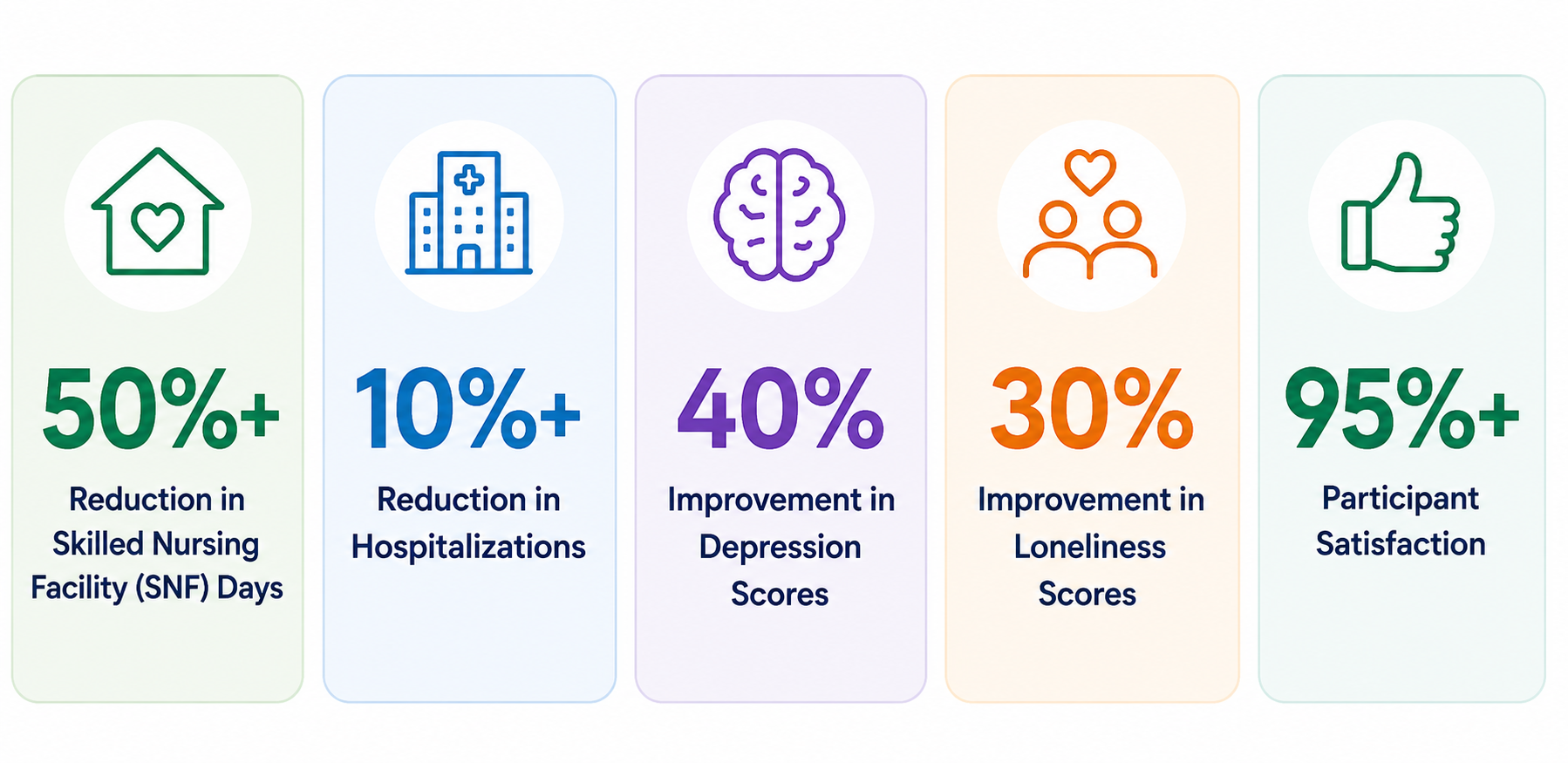
These outcomes are especially relevant for HCBS organizations working to help older adults remain safely in community settings. Reducing skilled nursing facility utilization and avoidable hospitalizations while improving behavioral health and participant experience can strengthen the ability of HCBS programs to support independence and reduce reliance on higher-acuity care.
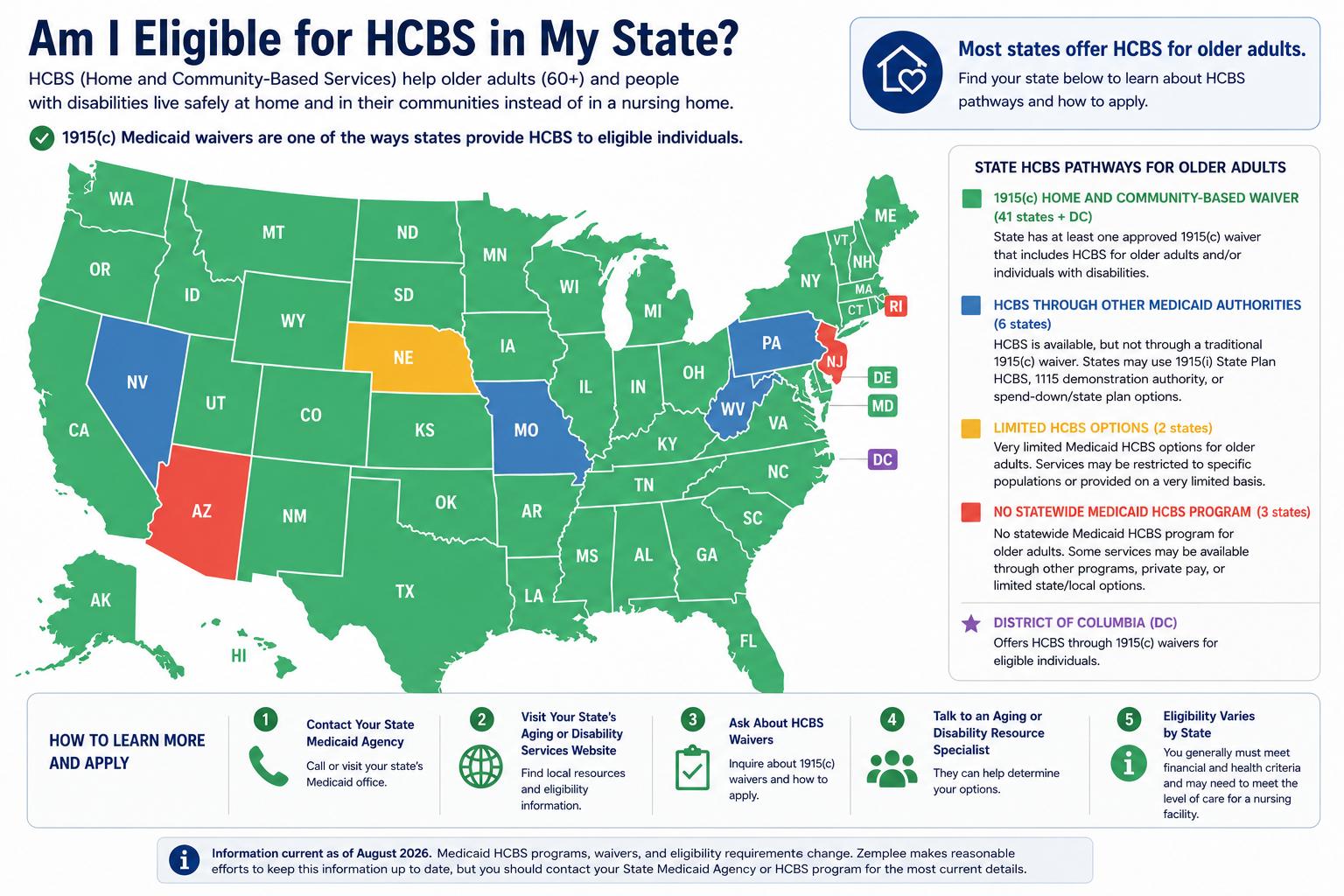
Medicaid Home and Community-Based Services (HCBS) help eligible older adults and people with disabilities receive long-term services and supports in their homes and communities. Eligibility, covered services, and the Medicaid pathway used to provide HCBS vary by state. The map below provides an overview of how states make HCBS available to older adults.
Built for Organizations Delivering Care in the Community
Zemplee can support organizations responsible for coordinating services and monitoring older adults and other high-risk individuals across home and community settings.
- Medicaid HCBS programs and waiver providers
- Area Agencies on Aging and community-based organizations
- Managed care and Medicaid health plans
- Home care and home health organizations
- Programs supporting transitions from institutional to community-based care
- Organizations managing high-risk or complex populations in the community
How Zemplee Supports HCBS Programs
Zemplee combines passive monitoring, remote health monitoring, voice-enabled engagement, and AI-powered care intelligence to help HCBS teams maintain visibility between visits and focus attention where it is needed most.
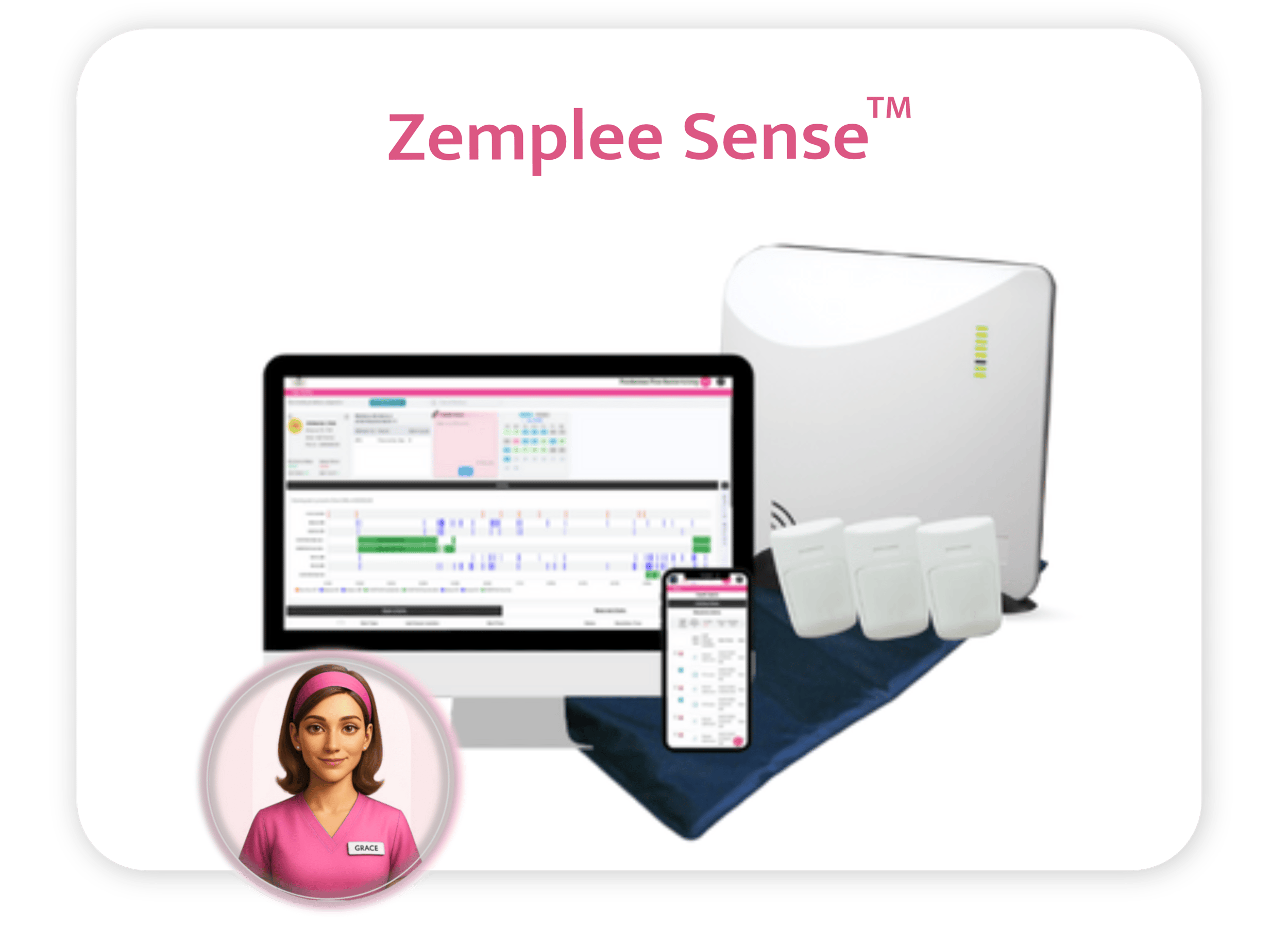
- Zemplee Sense™ — Ambient Monitoring: Passively monitors movement, activity, sleep, bathroom patterns, and other daily routines without cameras or requiring participants to wear devices.
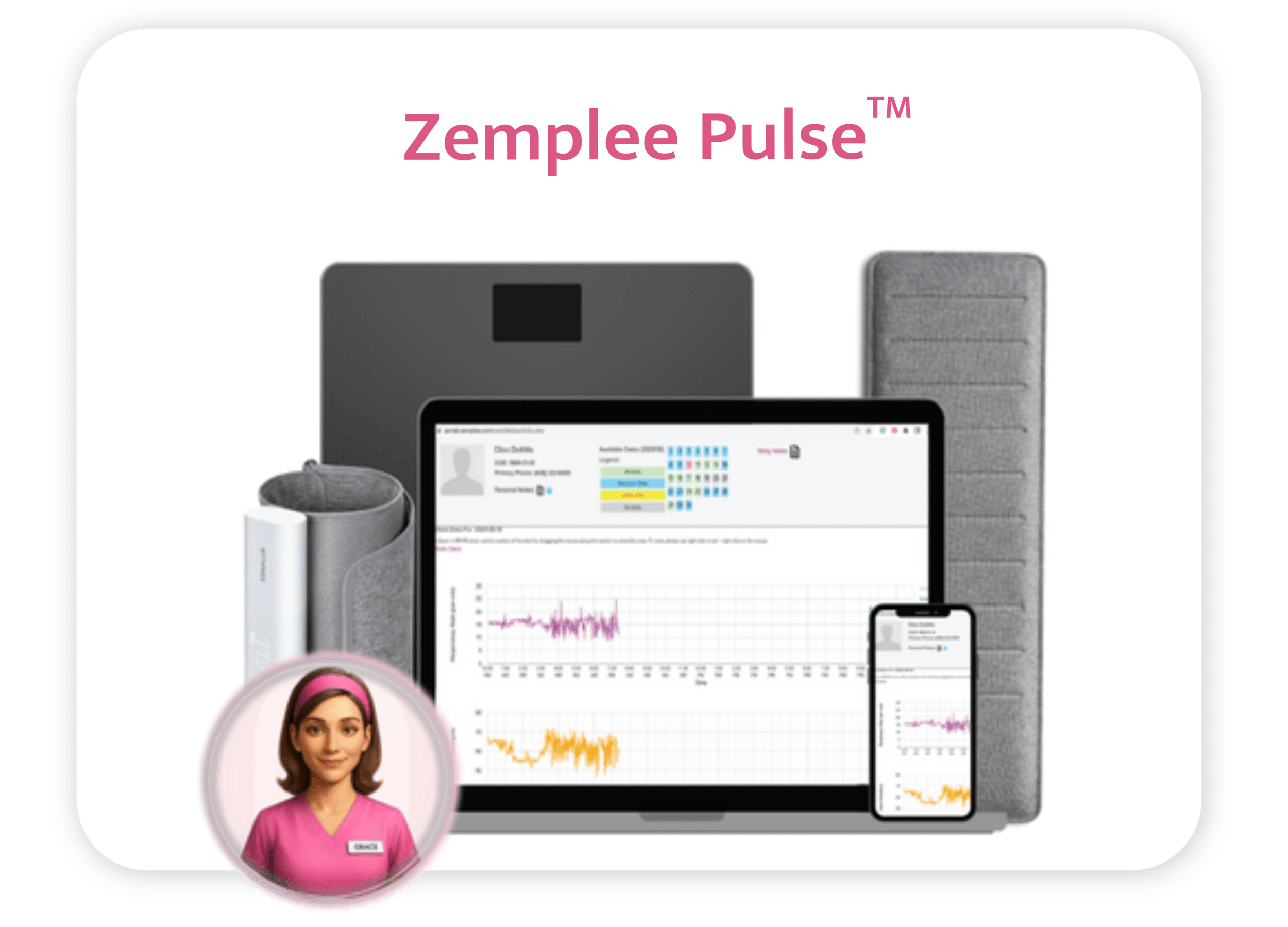
- Zemplee Pulse™ — Remote Health Monitoring: Captures health measurements such as blood pressure, heart rate, oxygen saturation, and glucose using connected monitoring devices when clinically appropriate.
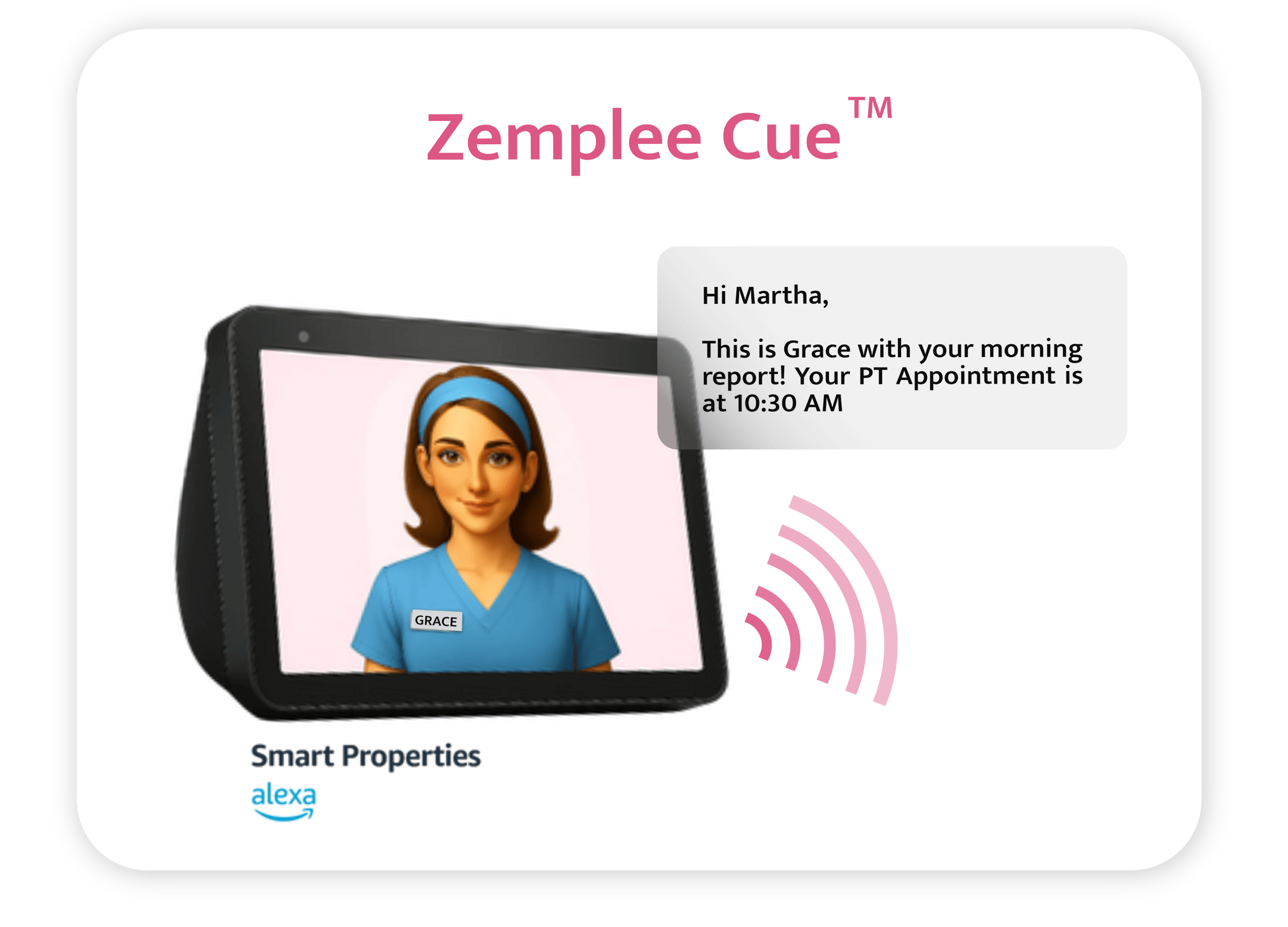
- Zemplee Cue™ — Voice-Enabled Engagement: Supports check-ins, reminders, wellness prompts, and social engagement through voice technology.
- Attentive AI™ — Care Intelligence: Learns individual patterns, identifies meaningful changes, and helps turn monitoring data into actionable information for care teams
Frequently Asked Questions About Technology for HCBS
How can Zemplee help HCBS programs reduce skilled nursing facility utilization?
Zemplee's passive, wearable-free and camera-free monitoring technology helps HCBS programs identify changes in safety, activity, health, and daily routines between in-person visits, enabling care teams to respond earlier when risks emerge. The technology acts like a round-the-clock attendant in the home—continuously paying attention to meaningful changes without requiring an older adult to wear, charge, or activate a device and without using video cameras. This continuous awareness is the foundation of Zemplee's Attentive AI™, which learns an individual's normal patterns and helps surface changes that may require attention. In a real-world community-based care program using Zemplee technology, skilled nursing facility days decreased by more than 50%, alongside reductions in hospitalizations and improvements in participant well-being.
How can Zemplee help HCBS programs defer nursing home placement?
Zemplee's passive remote monitoring technology, powered by Attentive AI™, transforms the homes of HCBS participants into digital caring environments. It provides 24/7 observation of activities, falls, mobility, and other daily living routines without requiring continuous in-person supervision. A smart alerting system notifies care teams when meaningful changes or potential risks are detected, helping them intervene earlier and coordinate appropriate support. By extending visibility between scheduled visits, Zemplee can help HCBS programs address emerging risks before they escalate and strengthen their ability to keep participants safely supported in the community and defer avoidable nursing home placement.
How can Zemplee support transitions from nursing facilities back to the community?
Zemplee can help HCBS programs create a safer care environment for participants transitioning from nursing facilities back into their homes and communities. A common barrier to community transition is the lack of continuous visibility and support in the home after discharge. Zemplee adds that additional layer of support by monitoring daily activities, mobility, fall risk, changes in routine, and health indicators when appropriate, while smart alerts notify care teams when potential risks require attention.
This additional layer of support can help create the conditions for nursing facilities and HCBS teams to safely transition appropriate participants back into community settings. By extending care-team visibility into the home, Zemplee can support repatriation from nursing facilities, earlier intervention after discharge, and the participant's ability to remain safely in the community.
How can Zemplee help HCBS programs reduce avoidable hospitalizations?
Zemplee helps HCBS care teams identify changes in a participant's health, activity, mobility, and daily routines before those changes become more serious. Passive monitoring provides visibility between scheduled visits, while remote health monitoring can capture clinical measures when appropriate. Smart alerts help care teams recognize meaningful changes and coordinate earlier follow-up or intervention.
In a real-world community-based care program using Zemplee technology, hospitalizations decreased by more than 10%. By helping care teams identify emerging risks earlier, Zemplee can support the HCBS goal of keeping participants healthier and safely supported in the community.
How can Zemplee help HCBS programs reduce falls and improve fall prevention?
Zemplee helps HCBS programs move from reactive fall detection toward proactive fall prevention. Passive monitoring provides continuous visibility into participants' mobility, activity patterns, nighttime movement, bathroom routines, and other changes in daily living that may indicate increasing fall risk. Attentive AI™ learns an individual's normal patterns and helps identify meaningful changes or potential safety events so care teams can intervene earlier.
Zemplee Cue™, an Alexa-based skill companion, adds an intervention and engagement layer by providing situational guidance directly in the home. Cue can deliver reminders, prompts, and appropriate guidance that reinforce safer behaviors and help participants navigate daily activities.
Together, continuous monitoring, intelligent alerts, care-team intervention, and situational guidance create a more proactive approach to fall prevention—helping HCBS organizations identify risk, respond earlier, and support participants in remaining safely in the community.
Why Fall Prevention Matters for HCBS?
Falls are a major threat to older adults' ability to remain safely and independently in their homes and communities. The National Council on Aging's 2025 National Falls Prevention Action Plan calls for reducing fall-related emergency department visits among adults age 65 and older and identifies new technologies, evidence-based interventions, partnerships, and better data as important components of the national strategy.
HCBS programs are uniquely positioned to contribute to this goal because they support older adults where many falls occur—in their homes and communities. Zemplee extends that support between scheduled visits through passive monitoring, Attentive AI™, intelligent alerts, and situational guidance, helping care teams identify changing fall risk and intervene earlier.
How can Zemplee help HCBS programs address loneliness and depression?
Older adults receiving HCBS may experience loneliness or depressive symptoms for many reasons, including social isolation, loss of mobility or independence, chronic illness, bereavement, reduced social interaction, and fewer opportunities to participate in meaningful activities. These changes can be difficult for care teams to recognize when they occur gradually between scheduled visits.
Zemplee helps HCBS programs extend visibility and engagement into the participant's home. Changes in sleep, activity, daily routines, mobility, and other behavioral patterns can provide additional context about a participant's well-being. Zemplee Cue™ adds a voice-based engagement layer that can provide check-ins, reminders, mindfully programmed entertainment, and mentally engaging activities, while helping participants stay connected with friends and family between in-person visits.
For the older adult, this additional layer of connection and awareness can provide a sense of reassurance and peace of mind—like having a safety net in the home. Participants can maintain their independence while knowing that meaningful changes or potential risks can be surfaced to their care team, and that support remains connected even when a caregiver is not physically present.
In a real-world community-based care program using Zemplee technology, participants experienced approximately 40% improvement in depression scores and 30% improvement in loneliness scores, with participant satisfaction above 95%. These results demonstrate how technology-enabled support can complement—not replace—human care while helping HCBS programs address both physical and psychosocial dimensions of community living.
Who is eligible for Zemplee through an HCBS program?
Older adults enrolled in a Medicaid Section 1915(c) Home and Community-Based Services waiver may be able to receive remote monitoring or related technology when it is included as an authorized service in their state's waiver and their person-centered care plan. Section 1915(c) waivers are designed to help eligible individuals who would otherwise require an institutional level of care receive long-term services and supports in their homes and communities instead.
Eligibility and covered services vary by state, waiver program, target population, level-of-care requirements, and individual care plan. Participants and families should speak with their HCBS case manager, care coordinator, Medicaid agency, managed care plan, or waiver provider to determine whether Zemplee or remote monitoring can be authorized as part of their services.
Families can also contact Zemplee to help identify the appropriate pathway in their state.
How can older adults and families get Zemplee?
Older adults and families can access Zemplee through participating HCBS programs, Medicaid waiver providers, home care and home health agencies, PACE programs, and other organizations supporting people in the community. For individuals enrolled in a Medicaid Section 1915(c) HCBS waiver, families can ask their case manager or care coordinator whether remote monitoring or assistive technology can be included as an authorized service in the participant's person-centered care plan.
Families can also contact Zemplee directly. Our team can help determine whether Zemplee is available through an existing care program, explore potential Medicaid or HCBS pathways in their state, or discuss options for accessing Zemplee at home.
Build a Stronger Safety Net for HCBS Participants
See how Zemplee can help your organization extend visibility between visits, identify emerging risks earlier, and support more participants safely in their homes and communities.